

Cracking the Mobile Money Code
Airtime, Credit, and the Power of Everyday Transactions

By Metasebia Yoseph, Founder & CEO, Addis Futures Lab
While deep in the development of a new credit-scoring tool for women and youth, I was exploring nuanced data sources in order to map financial-behavior patterns. Somewhere between analyzing transaction flows and defining new risk categories, a question emerged: What if the most powerful on-ramp to financial inclusion was already in people’s hands?
Airtime is often dismissed as a consumable; something to be purchased, used, and forgotten. But for millions of Ethiopians, the airtime on their phones already behaves less like a utility and more like a financial instrument. It’s bought frequently, often in small denominations. It’s transferred peer-to-peer. People budget around it, temporarily store value in it, and trust its digital ledger. All of this without onboarding campaigns, financial literacy training, or learning new digital habits. It’s the most frictionless pathway to widespread mobile money usage at scale.
Airtime doesn’t ask users to create accounts, remember passwords, adopt new digital tools or behaviors. It works reliably on both smartphones and feature phones (USSD). It’s already woven into the economic fabric of daily life. In other words, airtime transactions already mirror the very financial behaviors policymakers and fintech builders are trying to cultivate.
Existing Patterns
Many African countries are currently leveraging the economic power of airtime far beyond as a qualifier for credit scoring or micro-loans and recognizing it as a proxy store of value. Countries like Nigeria, Ghana, and Lesotho have formal platforms dedicated to converting airtime into cash. While Uganda, Egypt, Cameroon, DRC, and Somalia have developed informal markets where airtime serves as a parallel currency. In these contexts, people use airtime as a temporary store of value and convert it back to cash or services as needed. These models operate in regulatory environments that formally or informally permit airtime conversion. Ethiopia does not, at least not yet.
A New Policy Frontier
Currently, Ethiopian law doesn’t allow for the conversion of airtime back to cash. It’s a one-way transaction. You buy airtime, you use it for calls and data, and that’s it. Telebirr explicitly does not permit third-party airtime-to-cash conversions, leaving prepaid airtime as non-redeemable telecom credit.
At the same time, the National Bank of Ethiopia’s updated Digital Payments Strategy (2026–2030) emphasizes expanding active digital participation, moving beyond account ownership to routine, everyday use, particularly among women, youth, and informal-sector participants. Yet, the strategy ignores the clearest pathway for the most frictionless onboarding mechanism available: the behaviors people are already practicing through airtime.
The question isn’t whether airtime should become freely convertible into cash, but whether a well designed low-value conversion framework could activate airtime’s latent economic power and bring millions into mobile money participation without producing systemic risks.
From Behavior to Inclusion
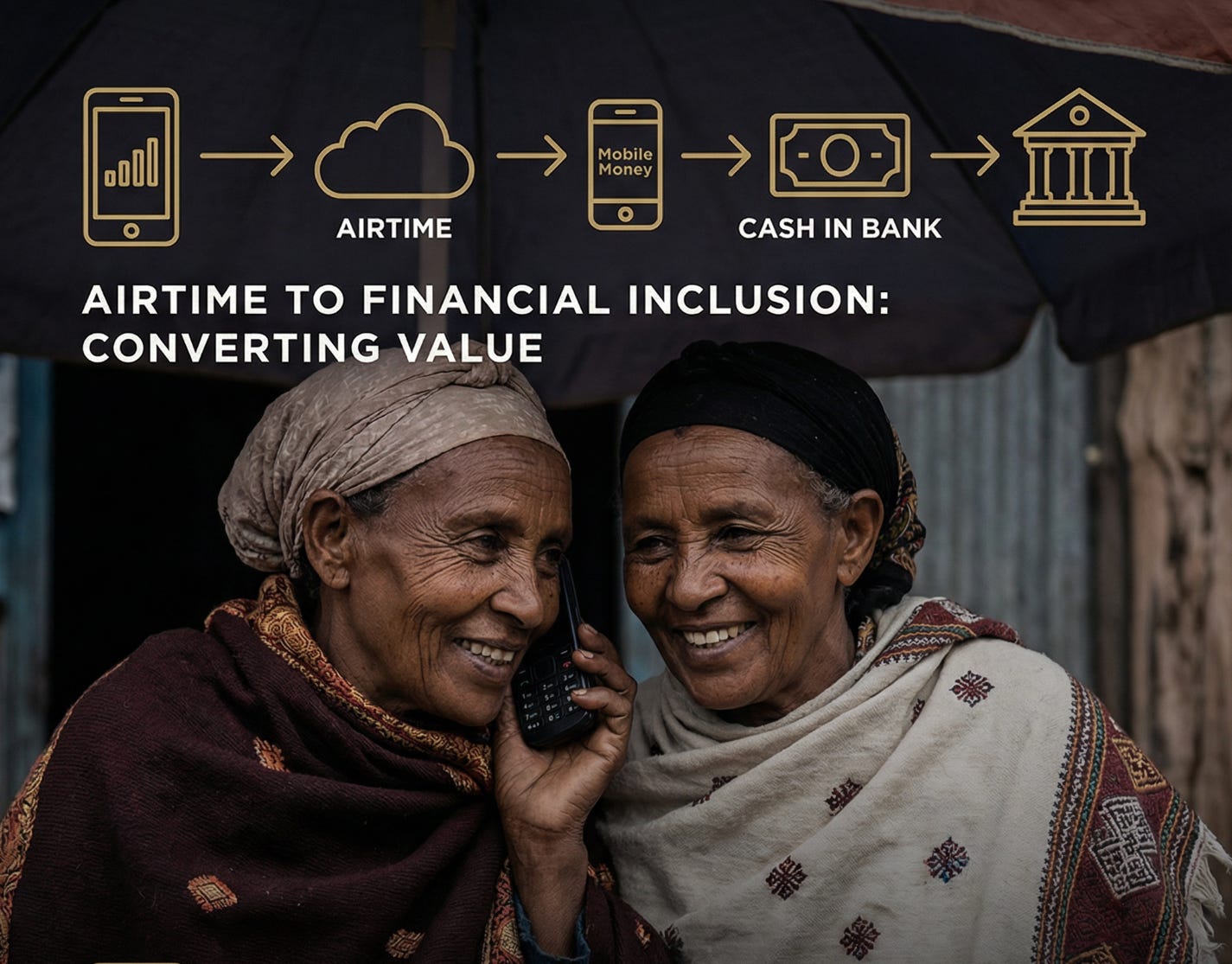
The architecture is simple:
